Interpretation of the Sumerian King List

Author: Dr. Dr. Robin Wellmann

The interpretation of the Sumerian king list presented in this article is based on the new translation published here.
Interpretation of the Sumerian King List
Introduction
The Sumerian King List (SKL) ranks among humanity’s oldest historiographical documents. It was likely compiled in its known form during the Old Babylonian period (ca. 1900–1600 BCE) and records dynasties from the mythical origins of kingship to historically attested times. The most famous exemplar is the Weld-Blundell Prism WB 444, now housed in the Ashmolean Museum in Oxford.
Since the first publication by Langdon (1923) and the authoritative critical edition by Jacobsen (1939), a fixed translation tradition has been established that interprets the text primarily through Akkadian lexica and grammar. This tradition understands the SKL as a chronological list of rulers with their respective reign lengths.
However, the traditional interpretation encounters significant difficulties. The astronomically high year numbers of the antediluvian kings—up to 43,200 years for a single ruler—appear biologically impossible. Moreover, many of the named pre-Sargonic rulers cannot be verified through any other early sources. These problems led to the SKL frequently being dismissed as a mythical-propagandistic construct that primarily served to legitimize the Akkad dynasty.
A new translation based on the original meanings of the Sumerian cuneiform signs—rather than on later Sumerian-Akkadian dictionaries—opens an entirely different perspective. The present translation demonstrates that the SKL is neither a naive list of rulers nor a propaganda document, but rather a complex system for documenting the divine and human labor invested in the development of human civilization.
The central insights of this reinterpretation can be summarized as follows:
- The year numbers do not document the reign lengths of individual kings, but rather the accumulated labor of all actors involved in a civilizational development step—both gods and humans.
- Many of the supposed royal names are in fact semantically transparent descriptions of historical events or cultural developments.
- The text contains accounts of Genesis and the Flood, as well as references to biblical figures such as Adam and Noah.
The SKL as a Record of Divine Labor
The Year Numbers as Accumulated Labor
The key to understanding the astronomically high numbers in the SKL lies in the correct translation of the recurring formula “mu N i₃-ak.” The traditional translation “he reigned N years” proves to be a fundamental misunderstanding.
A sign-based analysis yields instead: “This took N work-years of the great ones to complete.” The formula thus documents not the lifespan or reign of a single person, but the totality of labor expended by gods and other “great ones” for a specific civilizational development step.
This interpretation solves the riddle of the antediluvian numbers: When 64,800 work-years are given for the Eridu period, this does not designate the biologically impossible lifespan of two individuals, but rather the sum of all divine and human efforts required to establish the first administrative structures.
At the end of each dynasty, a summation formula appears that confirms this principle: “These M types of kingship required N work-years of the great ones to complete.” The individual entries form a consistent system of accumulation.
Royal Names as Event Descriptions
Another key to the reinterpretation lies in recognizing that Sumerian, as an agglutinative language, functions differently from Indo-European languages. While in languages like English or Akkadian, proper names are usually opaque, non-analyzable units, in many authors the meaning of Sumerian words emerges transparently from the combination of their individual cuneiform signs.
What was traditionally read as the royal name “Alulim” actually means: “The labor of humans, the supervision of great humans.” This is not the name of a person, but the description of a civilizational achievement—namely, the establishment of labor organization and supervisory structures.
Similarly with “Alalgar”: “The labor of priests, who were installed as a new institution and whose task is to create bonds to their cities.” Here, the emergence of the priesthood as an institution is documented.
This reading explains why many “rulers” of the SKL are not attested in other sources: they are not persons at all, but descriptions of developmental phases. The systematic confusion of causality with genealogy in traditional translation has led to absurd king lists in which abstract concepts appear as monarchs.
The Concept of “nam-lugal”
The Sumerian word “lugal,” traditionally translated as “king,” consists of two signs: “gal” (great/significant) and “lu₂” (human). The literal meaning is thus “great human” or “the great/significant one with a human body.”
A “lugal” differs from other humans not by occupying a throne, but by accomplishing significant deeds. This definition explains why persons who were not kings in the conventional sense can also be designated as “lugal” in the SKL: they were “significant” with regard to their civilizational importance.
The “nam-lugal,” the “fate of kingship,” is accordingly not an inheritable position, but a divine calling that makes humans instruments of civilizational progress. The formulation that the fate of kingship “descended from heaven” establishes the divine legitimation of all historical development.
The Dramatically Decreasing Work-Years
A particularly revealing pattern emerges in the dramatic decrease of work-years over the course of the SKL:
The numbers decline from over one hundred thousand years to just a few decades. This pattern can be interpreted as an expression of increasing human competence: the further civilization progresses, the less divine support is required. The fundamental civilizational innovations of early times—the establishment of division of labor, priesthood, legal systems—required immense divine investment. Later dynasties could build on this foundation and accordingly required less divine labor.
This system of a “divine labor economy” is unique in ancient historiography. It conceives of history not as a sequence of events, but as an administrative task of the gods, who must strategically deploy their working time to advance humanity.
The Phases of Civilizational Development
The Programmatic Significance of City Names
Just as with the supposed royal names, many city names in the SKL prove to be not mere geographical designations, but semantically transparent descriptions. They characterize developmental phases of Mesopotamian civilization and reveal a sophisticated system of historical conception.
Several examples illustrate this principle:
Bad-Tibira: “Fortified cities of joy dedicated to craftsmanship”
Hamazi: “The place of the life-seeds of the boat that unfolds life”
Akkad: “The city whose transformative power is the exhaustion of resources for sustaining life”
Akšak: “The city of light for the despised”
These translations show that the “dynasties” of the SKL do not primarily designate political domains, but civilizational development programs. The so-called “Dynasty of Bad-Tibira” documents that phase in which fortified cities dedicated to craftsmanship were erected. The name Hamazi—”the place of the life-seeds of the boat that unfolds life”—unmistakably refers to the Ark and the preservation of life through the Flood.
Particularly revealing is the designation of Akkad as a city whose transformative power lies in the “exhaustion of resources.” This can be read as a sober description of imperial expansion: the Akkadian Empire under Sargon and his successors was based on the systematic exploitation of subjugated territories.
The Antediluvian Periods as Systematic Developmental Stages
The five antediluvian periods—Eridu, Bad-Tibira, Larak, Sippar, and Šuruppag—form a coherent sequence of civilizational foundations. Each phase builds upon the previous one and adds new elements:
Eridu Period: The Foundation of Human Organization
- Labor and supervision of significant humans
- Establishment of the priesthood as a new institution
- Creation of bonds between humans and cities
The text notes: “The allocations to these cities were weak.” This indicates that divine resources and divine knowledge were still limited in this early phase.
Bad-Tibira Period: The Emergence of Cultural Leadership
- Cultural leaders acting as divine forces
- Humans and great ones whose existence is bound to the sky gods
- Sky gods as “torchbearers of justice and integrity, who are shepherds of the people”
The concluding comment—”The weak allocations to these cities were the raw material for cultural leadership”—shows how cultural structures emerged from modest beginnings.
Larak Period: The Establishment of Just Rule
- Cultural leaders as “just and reliable shepherds of the people”
- Utilization of the “abundance of great things from which desired outcomes emerge”
Sippar Period: The Introduction of Law and Justice
- Places “that receive the light of Utu, the god of justice”
- Control over the exalted ones through divine law
- First mention of the criticized “malleable substance of the human soul”
The Sippar period marks a qualitative leap: for the first time, the human soul is thematized as malleable material that can be shaped through divine influence.
Šuruppag Period: The Final Antediluvian Phase
- A city “that provides the weak shell of the land’s existence,” which offered a unique occasion for joy to the gods, since its ruler utilized divine allocations in their interest and could therefore become the foundation for the Genesis that followed.
The Recurring Cities: Kish, Uruk, and Ur
A striking structural feature of the SKL is the repeated mention of three cities: Kish appears four times, Uruk five times, and Ur three times. Other important Sumerian cities such as Lagash and Nippur are largely absent.
Traditional scholarship explains this by noting that Kish, Uruk, and Ur competed for hegemony over Mesopotamia and that the title “King of Kish” held special legitimizing significance. This explanation is not entirely satisfactory, however, since other cities also held hegemony at times. Within the framework of the reinterpretation presented here, no definitive explanation for this pattern can be found either. Possibly the authors of the SKL were inhabitants of these three cities. The question merits further investigation.
The cyclical movement of the “nam-lugal” between these cities suggests an understanding of history as a sequence of centers of civilizational innovation. Each city has its time of greatness, during which the fate of kingship resides with it, makes its specific contribution to overall development, and then recedes when divine energy turns to a new center.
Local Dynasties and Their Specific Functions
Besides the recurring main centers, the SKL records several dynasties that appear only once, including Awan, Hamazi, Adab, Mari, and Akšak. These local dynasties fulfill specific narrative and historiographical functions.
Awan—the erased line: The Awan dynasty is remarkable because the names of its rulers are illegible in all surviving manuscripts. This systematic damage could indicate deliberate erasure—a damnatio memoriae for a line considered guilty.
Hamazi—the place of the Ark: With only a single entry—Ḫadaniš, “the unique self together with life-seeds”—and the programmatic city designation as “place of the life-seeds of the boat,” Hamazi stands at the center of the Flood narrative.
Adab—the completion of humanity: The unique time specification for Adab reads: “This took 90 work-years of the great ones to complete the seed of humanity.” This unique formulation points to a completion of human creation.
Mari—the renewal of the soul: The Mari dynasty repeatedly thematizes the human soul: “divine allocations to the human soul,” “the renewed soul of thinking humans,” “the energy-unfolding of the lamented malleable substance of the soul, which is priestly purified.” Mari appears as a place of spiritual regeneration after the Flood.
Genesis, the Flood and Gilgamesh
The traditional interpretation of the SKL assumes that the text is divided into two parts by the Flood: the antediluvian and the postdiluvian periods. The new translation, however, reveals a more complex picture. Both Genesis and the Flood are described in the text, but at different locations than previously assumed.
Genesis in Kish I
The passage traditionally understood as describing the Flood proves upon closer analysis to be a description of Genesis—the creation or transformation of humanity.
This section appears immediately after the Šuruppag period, which as the last of the five antediluvian periods describes those who are “the root of innovation regarding exaltedness”—that is, those humans who, due to divine influence, behaved in accordance with the gods’ wishes. The decisive sentence reads in the new translation:
“The transformative power for the weak human containers uses the allocations to those who are the root of innovation regarding exaltedness. After completion of the transformative power for the weak human containers, the allocations were used and slipped away from those who were the root of innovation regarding exaltedness.”
The “transformative power for the weak human containers” designates not the destructive force of water, but the creative power of the gods that bestowed souls upon humans. The “human vessels” are the human bodies that were equipped with consciousness and soul through divine intervention.
This interpretation is supported by the subsequent entries in Kish I:
“The force whose existence is bound to invisible forces of the sky gods and which acts invasively upon the unique energy-unfolding of the human vessels (and shapes them)” (historical: King Nanĝišlišma)
“The invisible force defined by the awe-inspiring judgment over cultural leadership that is bound to the sky gods” (historical: King En-Taraḫ-ana)
These passages describe how divine forces acted upon the “energy-unfolding of the human vessels”—that is, upon the neuronal development of the human brain. The purpose of this intervention was to enable humans to establish a high culture with social stratification.
The cuneiform sign 𒁰 (taraḫ), which appears in these passages, probably shows a mouth in profile making an authoritative statement with serious consequences. It can be translated as “awe-inspiring judgment.” The second meaning of the sign—”ibex”—refers to animals known for their butting, which supports the interpretation as an incisive, impact-like intervention.
Interestingly, the text also allows an alternative reading if one omits a certain sign—the “empty sign” for “invisible force”:
“The impacting sky-stone, the witnessed energy-unfolding of the land”
“The cultural leader defined by the impacting object from heaven that causes destruction”
This alternative reading points to a meteorite impact. It seems as though the author intended to offer both readings, with the second serving as a metaphor for the first: the divine intervention in human development was as incisive as a cosmic impact.
The Flood in Uruk I
The actual description of the Flood is found not at the traditionally assumed location, but in the Uruk I dynasty, after the entry on Gilgamesh. The relevant passages read:
“The abundance of allocated water that is released” (historical: King Laba’šum): This took 9 work-years of the great ones.
“En-nun-taraḫ-ana, the cultural leader whose existence is bound to the awe-inspiring judgment of the sky gods over the exaltedness”: This took 8 work-years of the great ones.
The first passage unmistakably describes a flood: “allocated water that is released.” The second passage explains the reason for the flood: an “awe-inspiring judgment of the sky gods over the exaltedness.” The Flood was thus a divine punishment for the misconduct of the exalted ones—those humans who had been endowed with special abilities through Genesis but misused them.
The theme of the Flood permeates other sections of the SKL as well. The dynasties of Awan, Hamazi, Adab, and Mari all contain references to water, boats, and the preservation of life-seeds.
Gilgamesh—an Ambivalent Figure
The description of Gilgamesh in the SKL is remarkably multifaceted and ambivalent. The complete entry reads:
“Gilgamesh, the invasive actor targeting the sky gods by exhausting their resources, the fool who causes harm, the divine woodcutter whose resource for sustaining life is reliance on his own strength; The one whose allocated source of life-force made that which constitutes the self defective. The cultural leader (who) was the one whose life (from the gods’ perspective) was dedicated to the unification of the allocated sources of life-force”
The descriptions contain both negative and positive elements:
Negative aspects:
- “The invasive actor targeting the sky gods by exhausting their resources”—Gilgamesh intruded into the divine sphere and exploited divine resources.
- “The fool who causes harm”—his actions are judged as foolish and harmful (derived from an alternative spelling of the name).
- “Whose allocated source of life-force made that which constitutes the self defective”—his divine endowment led to damage to his own being.
Positive aspects:
- “Whose life was dedicated to the unification of the allocated sources of life-force”—from the divine perspective, his life served a higher purpose.
- “The existence of a protective shell for the place of community, made possible by the loyalists of the great divine exalted one (Gilgamesh)”—the completion of the great walls of Uruk.
This ambivalence reflects the complex role of Gilgamesh in Mesopotamian tradition. He is both hero and transgressor, both divinely gifted and humanly fallible. The SKL shows him as someone whose extraordinary abilities had primarily destructive effects.
Then follows the Flood:
“The abundance of allocated water that is released”
The narrative sequence suggests a causal connection: the actions of Gilgamesh led to a condition that provoked divine judgment—the Flood.
Chronological Classification of the Dynasties
Gilgamesh Before the Flood
The new translation leads to a surprising chronological insight: Gilgamesh lived before the Flood, not after it. In the SKL, Gilgamesh appears in the Uruk I dynasty before the entries describing the Flood.
This insight seems to contradict the Epic of Gilgamesh, in which the hero seeks out Utnapishtim, the survivor of the Flood, and learns from him the story of the great deluge. A closer examination of the textual history of the Gilgamesh Epic, however, resolves this contradiction.
The Flood narrative probably does not belong to the original Sumerian Gilgamesh tales. It was only inserted into the narrative around the 12th century BCE and appears only in the version of the epic attributed to the scribe Sin-leqi-unninni.
Some scholars have suggested that an earlier form of the story may have ended with Siduri sending Gilgamesh back to Uruk, and that Utnapishtim was not originally part of the narrative at all. The Flood narrative was adopted from the older Atrahasis Epic and inserted into the Gilgamesh Epic because the immortality of the flood hero Utnapishtim fit the theme of the quest for immortality in the epic. The encounter between Gilgamesh and Utnapishtim is thus a literary construction of later editors, not a historical tradition.
The SKL, by contrast, which can be considered an older and independent source, places Gilgamesh chronologically before the Flood. This placement has far-reaching consequences for dating. Based on flood deposits at Šuruppag dated to approximately 2950 BCE, the Flood is usually placed in this period. If Gilgamesh lived before the Flood, however, he must have lived not around 2600 BCE as commonly assumed, but approximately 500 years earlier—around 3100 BCE.
This redating also implies that Genesis occurred approximately 500 years before the Flood, thus around 3500 BCE. All events between Genesis and Uruk III must accordingly be dated earlier than assumed in the traditional Middle Chronology.
The following figure shows the resulting chronological classification of the dynasties:
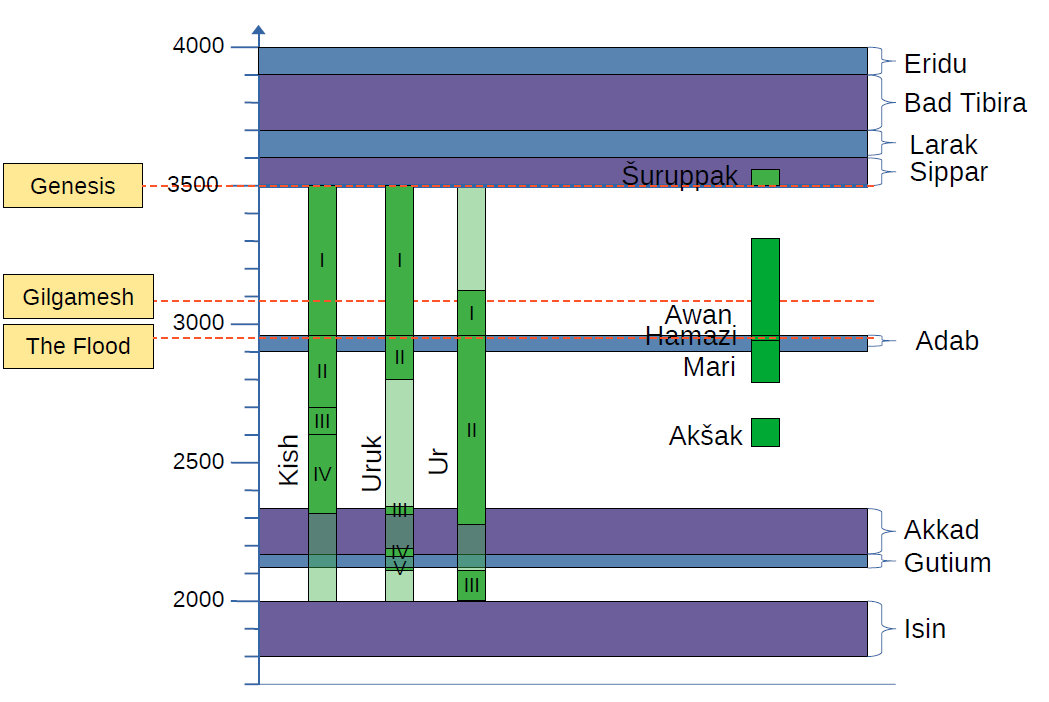
Royal Dynasties from the Sumerian King List
Chronological classification of royal dynasties from the Sumerian King List (4000–1800 BCE). The figure distinguishes between supra-regional dynasties that influenced large parts of Sumer (blue) and dynasties of individual Sumerian city-states (green). The transparent green bars indicate that the cities of Kish, Uruk, and Ur existed throughout the entire period under consideration according to archaeological excavations. The beginning of the Eridu phase (around 5300 BCE) lies outside the depicted timeframe.
Chronological classification of royal dynasties from the Sumerian King List (4000–1800 BCE). The figure distinguishes between supra-regional dynasties that influenced large parts of Sumer (blue) and dynasties of individual Sumerian city-states (green). The transparent green bars indicate that the cities of Kish, Uruk, and Ur existed throughout the entire period under consideration according to archaeological excavations. The beginning of the Eridu phase (around 5300 BCE) lies outside the depicted timeframe.
The figure illustrates several important aspects:
- The antediluvian periods (Eridu, Bad-Tibira, Larak, Sippar, Šuruppag) extend from approximately 5300 to 3500 BCE and are depicted as supra-regional phases.
- Genesis is placed around 3500 BCE, the Flood around 2950 BCE.
- Gilgamesh appears in Uruk I, chronologically before the Flood.
- The dynasties overlap considerably—they do not simply succeed one another, but partially exist in parallel.
- The recurring cities of Kish, Uruk, and Ur (left side) pass through multiple phases, while the local dynasties (right side) appear only once.
Connections to the Old Testament
The new translation of the SKL reveals remarkable correspondences to the genealogies and narratives of Genesis. These connections manifest in two central identifications that open new perspectives on the origins of biblical primeval history.
Meskiagasher and Adam
The first cultural hero after Genesis in the SKL bears traits that identify him as a Mesopotamian counterpart to Adam. The entry for Meskiagasher in Uruk I reads:
“Meskiagasher, the man who relies on his own strength, whose allocated resource is the earth, whose resource for sustaining life is the lamented grain, the torchbearer of the god Utu, who was cultural leader and king by divine intervention”
Several elements point to Adam:
- “Whose allocated resource is the earth”—Adam was created from earth and was given the earth to cultivate.
- “Whose resource for sustaining life is the lamented grain”—This recalls the curse upon Adam: “By the sweat of your brow you shall eat bread” (Genesis 3:19).
- “The torchbearer of the god Utu”—Utu is the god of justice. Adam was the first human to receive moral discernment.
Particularly revealing is the immediately following sentence:
“Meskiagasher’s source of life-force entered into the state of divine allocation through the sky gods. The divine bonds to that which sustains human existence were placed by the sky gods as a delivery at the unfinished workplace for completion of the main part.”
This passage describes how Meskiagasher received a new kind of soul—his “source of life-force” was transferred into a new state by the sky gods. This corresponds to the biblical notion that God breathed the breath of life into Adam, thereby distinguishing him from all other creatures.
Ḫadaniš and Noah—Hamazi as the Place of the Ark
The clearest connection between the SKL and biblical tradition is found in the dynasty of Hamazi. The city name itself—”the place of the life-seeds of the boat that unfolds life”—is an unmistakable description of Noah’s Ark.
The sole entry of this dynasty reads:
“Ḫadaniš, the unique self together with life-seeds, who was king by divine intervention: This took 6 šu-ši work-years of the great ones.”
The description “the unique self together with life-seeds” makes unmistakably clear what this concerns: a single human who was saved together with the seeds of life—the animals and his relatives on the Ark. This is Noah, the inhabitant of the Ark.
The equation of Ḫadaniš with Ziusudra (the Sumerian name) and Noah (the biblical name) represents the most direct connection between the traditions. All three figures fulfill the same narrative function: they are the sole survivors of the Flood who preserve life on earth.
The Final Entry: Suen-magir and the Boat with the Seeds of Life
A remarkable detail is found at the end of the SKL, in the final entry of the Isin dynasty:
“Suen-magir, the divine cultural leader with knowledge of the boat with the seeds of life: This took 11 work-years of the great ones.”
The SKL thus ends with a back-reference to the Ark—”the boat with the seeds of life.” This framing is hardly coincidental. The text, which begins with the creation of kingship and traverses the entire history of human civilization, closes with a reminder of that event which secured the continuity of life through the greatest catastrophe.
Suen-magir is described as someone who possesses “knowledge of” this boat. This could mean that he was a guardian of tradition who preserved knowledge about the Flood and the rescue—similar to the biblical patriarchs who passed the story down from generation to generation. It could also mean that Suen-magir was the final author of the King List.
From City Dynasties to Family History: The Biblical Transformation
The name correspondences between the SKL and Genesis are more than interesting curiosities. They attest to a common ancient Near Eastern narrative complex that was accentuated differently in various cultures.
The biblical version is characterized by consistent genealogization: what appears in the SKL as city dynasties and event descriptions is transformed in Genesis into family history. The developmental phases of entire civilizations are condensed into the life stories of individual patriarchs.
This transformation follows a clear theological program:
- Monotheistic condensation: The polytheistic polyphony of the SKL—with its numerous sky gods, city gods, and divine forces—is consolidated in Genesis into the action of a single God.
- Temporal condensation: The slow process of divine shaping of modern humans, which in the SKL encompassed thousands of years, is condensed in the Old Testament to just a few days.
- Moralization: The SKL documents successes and failures of civilizational development relatively neutrally. Genesis interprets the same events as a moral story of obedience and disobedience, sin and punishment.
The decisive achievement of the biblical authors lay not in the invention of new narratives, but in the radical theological recoding of existing material. The fundamental narrative structures remained recognizable but received new meaning: divine work-years became divine providence, changing city fates became the history of chosen families.
The transmitted Worldview
The new translation of the SKL opens fundamental insights into the Sumerian worldview and its conception of historical processes. The text proves to be not a naive list of rulers, but the expression of a complex philosophy of history.
History as a Divinely Guided Civilizational Process
At the center of the Sumerian understanding of history stands the concept of “nam-lugal,” the fate of kingship. The recurring introductory formula makes this clear:
“The process of assigning the fate of kingship, which is applied to the sphere of influence of the sky gods by placing it at this unfinished place as a resource, bestows the fate of kingship upon…”
History, in this perspective, is not the result of human decisions or random events, but the realization of a divine plan for civilizational development. The formulation that the fate of kingship descended from heaven establishes the divine legitimation of all historical development.
The nam-lugal is not a static gift, but a dynamic process. It “goes” or “is brought” to various places, depending on where the gods wish to initiate the next developmental push of civilization. The seemingly arbitrary power shifts between various cities in the SKL thus receive a deeper meaning: each city receives the fate of kingship for a specific task and passes it on when that task is fulfilled.
This conception does not exclude the possibility that other cities simultaneously had rulers who called themselves kings. The SKL does not claim to provide a complete list of political rulers. Rather, it documents where at a given time the focus of divinely guided civilizational development lay.
The Interaction Between Divine and Human Spheres
The system of accumulated labor reveals a complex understanding of the interaction between divine and human spheres. Humans in this conception are simultaneously actors and instruments—they accomplish “significant deeds,” but are guided and supported by divine forces in doing so.
The antediluvian periods required immense divine investments because the fundamental structures of civilization first had to be created. The establishment of division of labor, priesthood, legal systems, and urban organization were tasks that humans alone could not accomplish. With increasing civilizational progress, however, humans became more capable of mastering civilizational tasks with less divine support.
This notion implies a kind of divine pedagogy: the gods work toward making humans feel more independent. The goal is not eternal tutelage, but gradual emancipation—albeit within the order established by the gods.
At the same time, the SKL shows that setbacks are possible and catastrophic. The Flood was such a catastrophe. Yet even after the greatest destruction, the fundamental impulse toward civilizational development remains preserved because it is of divine origin.
The Rhetorical Question in the Akkad Section
A remarkable example of the text’s self-reflection is found in the Akkad dynasty. After the enumeration of the great kings—Sargon, Rimuš, Maništiššu, Naram-Suen, and Šar-kali-šarri—a rhetorical question appears:
“Which divine allocations supported the kingship? Which divine allocations failed to support the kingship?”
This question is unique in the SKL. The text interrupts its documentary style to explicitly reflect on success and failure. The four entries that follow answer the question:
“The permanently repeated lament of the king” (historical: King Irgigi) “The dark life-force of the king” (historical: King Imi) “The failed strengthening of the invisible forces of the king” (historical: King Nanum) “The life-force of the subordinate humans of the king” (historical: King Ilulu)
These four entries describe not rulers, but factors of decline: lament, darkness, failed strengthening, dependence on subordinates. The text analyzes why the mighty Akkadian Empire collapsed.
The laconic remark “These four things required 3 work-years of the great ones to complete” underscores the rapidity of decline: what generations had built up disintegrated in the shortest time.
This passage shows that the SKL is not a mere register, but a reflective work that contemplates the conditions of rise and fall. The gods support civilizational development, but their support can also fail—whether through human failure, through droughts, or through the absence of the right divine allocations.
Time as Qualitative Accumulation of Labor
The understanding of time as expressed in the SKL differs fundamentally from modern conceptions. Time is not primarily measured linearly, but understood qualitatively as the accumulation of labor.
The question “How long did this period last?” is not answered with “X years passed,” but with “X work-years were required.” The difference is fundamental: it is not about the mere passage of time, but about the amount of labor invested.
This conception explains why the numbers in the SKL cannot be understood as chronological data in the modern sense. They measure not duration, but effort. A phase that required 108,000 work-years was not necessarily longer than a phase with 108 work-years—it was more labor-intensive.
Progress, in this understanding, is not automatic or inevitable. It requires continuous efforts from both gods and humans. The decreasing numbers over the course of the SKL show that these efforts became more efficient over time—not that less work was done, but that the same work showed greater effect.
Conclusion
The new translation of the Sumerian King List marks a turning point in our understanding of this key text of ancient Mesopotamian historiography. The consistent application of a sign-based translation method has made accessible a text that proves far more complex than previously assumed.
The SKL is not the naive product of an early age that could not distinguish myth from history. It is a sophisticated system for documenting civilizational development that integrates various levels of reality—divine and human—into a coherent overall narrative.
Three central insights crystallize:
- First, the SKL proves to be not a chronological list of rulers, but a documentation of divine and human labor invested in the development of civilization. The year numbers traditionally interpreted as reign lengths represent accumulated work-years of all actors involved in the respective historical or mythical event. This insight solves the problem of the astronomically high numbers discussed since Langdon (1923): these are not biologically impossible lifespans of individual rulers, but the sum of labor required to accomplish certain civilizational developmental phases.
- Second, the analysis shows that many of the supposed proper names actually represent descriptive designations for historical events or mythical episodes. This semantic transparency makes it possible to recognize narrative structures where traditional translation saw only a mechanical listing of names.
- Third, the new translation reveals deep connections between the SKL and the Old Testament. The text treats Genesis and the Flood, it explains the creation of the human soul, and it mentions figures who can be identified as Mesopotamian counterparts to Adam (Meskiagasher) and Noah (Ḫadaniš).
The SKL thus proves to be a key text not only for Mesopotamian studies, but for our understanding of the emergence of historical consciousness altogether. It documents perhaps humanity’s first attempt to place its own development within a larger, meaningful context and thereby synthesize various traditions, myths, and historical memories into an overall narrative.
The connections to biblical tradition show that the great narratives of Genesis—creation, fall, flood—were not isolated inventions, but part of a common ancient Near Eastern narrative complex that was elaborated differently in various cultures. The biblical authors did not invent this material, but theologically transformed it: polytheistic polyphony became monotheistic salvation history, city dynasties became family stories, documentary neutrality became moral narrative.
At the same time, the investigation counsels methodological modesty. The complexity and foreignness of Sumerian thought resist simple interpretations. Every advance in understanding opens new questions and reveals the limits of our knowledge. Despite the new translation presented here, the SKL remains an enigmatic text that will challenge future generations of researchers.
Sumerian culture, as one of the roots of our civilization, deserves the effort of such a reinterpretation. The SKL, this extraordinary text at the threshold of history, still has much to tell us—if we are willing to listen closely.