Understanding Cuneiform Signs

See also
-
- Learning Sumerian
Understanding Cuneiform Signs
Author: Robin Wellmann
Date of Publication: 27.03.2026 Last Revision: 29.03.2026
Abstract: Weite Teile der Forschung gehen davon aus, dass sumerische Keilschriftzeichen im Zuge ihrer Abstraktion von piktographischen Vorläufern ihre visuelle Motivierung verloren haben und ihre Bedeutung nicht aus ihrer Form erschlossen werden kann. Der vorliegende Beitrag stellt diese Annahme infrage. Er zeigt, dass ein erheblicher Teil der Keilschriftzeichen aus identifizierbaren Teilzeichen zusammengesetzt ist, deren Einzelbedeutungen die Gesamtbedeutung des Zeichens konstituieren – auch und gerade bei Zeichen, die abstrakte Konzepte bezeichnen. Der bisherige Fehlschluss beruht darauf, dass die Forschung nach piktographischer Ähnlichkeit zwischen Zeichenform und bezeichnetem Objekt sucht, anstatt die Zeichenform als semantische Komposition zu analysieren. Anhand einer systematischen Unterscheidung zwischen Momentaufnahmen (zwei Raumdimensionen) und Raum-Zeit-Diagrammen (eine Raum- und eine Zeitdimension) sowie der Identifikation von Modifikationsverfahren wird ein Analyserahmen entwickelt, der die Bedeutungserschließung aus der Form in vielen Fällen ermöglicht. Die Tragfähigkeit dieses Ansatzes wird an ausgewählten Zeichen demonstriert. Die Zeichenanalysen werden als fortlaufend ergänzte Sammlung bereitgestellt.
Introduction
Sumerian cuneiform, which originated around 3300 BCE in Mesopotamia, is considered one of the oldest writing systems in human history (Spar 2004; Walker 1987). Its sign inventory, which was reduced from an original approximately 1,500 to around 600 signs over the course of the 3rd millennium BCE, forms the basis of a logo-syllabic writing system in which signs can function both as logograms (word signs) and as syllabograms (syllable signs) (Crisostomo 2019; Borger 2004). The question of the extent to which the meaning of these signs can be derived from their visual form touches upon a central problem in the study of the ancient Near East. It is predominantly answered in the negative in the scholarly literature — a misconception, as we shall see.
Previous state of research
In much of the survey literature, the view has become established that Sumerian cuneiform signs underwent a profound “loss of iconicity” in the course of their development. While the proto-cuneiform precursors of the Uruk IV phase (c. 3300 BCE) still bore recognizably pictographic character — a bull’s head for “cattle,” an ear of grain for “barley,” three mountain peaks for “mountain range” — several transformations caused this pictorial reference to be progressively lost (Nissen, Damerow, and Englund 1993). The transition from a pointed, incising stylus to a blunt-tipped reed stylus pressed into the clay meant that curved lines were replaced by straight, wedge-shaped impressions. In addition, the signs were rotated 90° counterclockwise, though the precise timing and course of this reorientation remain debated in the literature (Powell 1981). This reorientation further estranged the already abstracted forms from their original pictorial reference (Englund 1998).
Against this background, the view has become established in scholarship that cuneiform signs in their mature form — from the Early Dynastic through the Neo-Assyrian and Neo-Babylonian periods — no longer bear any visual connection to the concepts they denote. In his account for the Metropolitan Museum, Ira Spar (2004) emphasizes that even among the earliest pictograms, the majority were of an abstract nature and could not be identified with known objects. The Encyclopaedia Iranica notes that the signs lost their pictographic character rather early and became abstract (Schmitt 1993). Goldwasser (2017) likewise highlights that cuneiform, unlike Egyptian hieroglyphs, lost its iconicity early and subsequently functioned primarily as a linguistic tool. The asserted loss of iconicity is further supported by the observation that not all signs were of pictographic origin even in the proto-cuneiform phase: Nissen identified 98 entirely abstract signs already in the Uruk III phase and emphasized that even the pictorial signs were rarely naturalistic, but were already highly schematized (Nissen 1986).
A more nuanced view
The seemingly established position that the meaning of Sumerian cuneiform signs cannot be derived from their form requires, however, a significant qualification. It fails to recognize a fundamental structural feature of the cuneiform sign inventory: a considerable proportion of signs are not monolithic but composed of identifiable sub-signs — and the meaning of the composite sign can frequently be derived from the meanings of these components, even when the denoted concept is abstract.
Cuneiform employs two main types of composite signs. On the one hand, there are compound signs, in which two or more independent signs are placed in linear sequence and read as a unit (ETCSL Sign List). On the other hand, there are complex signs, in which one sign is inscribed within another, notated in modern transliteration with the multiplication sign × (ETCSL Sign List). In both cases, the overall meaning can often be derived from the semantic combination of the components.
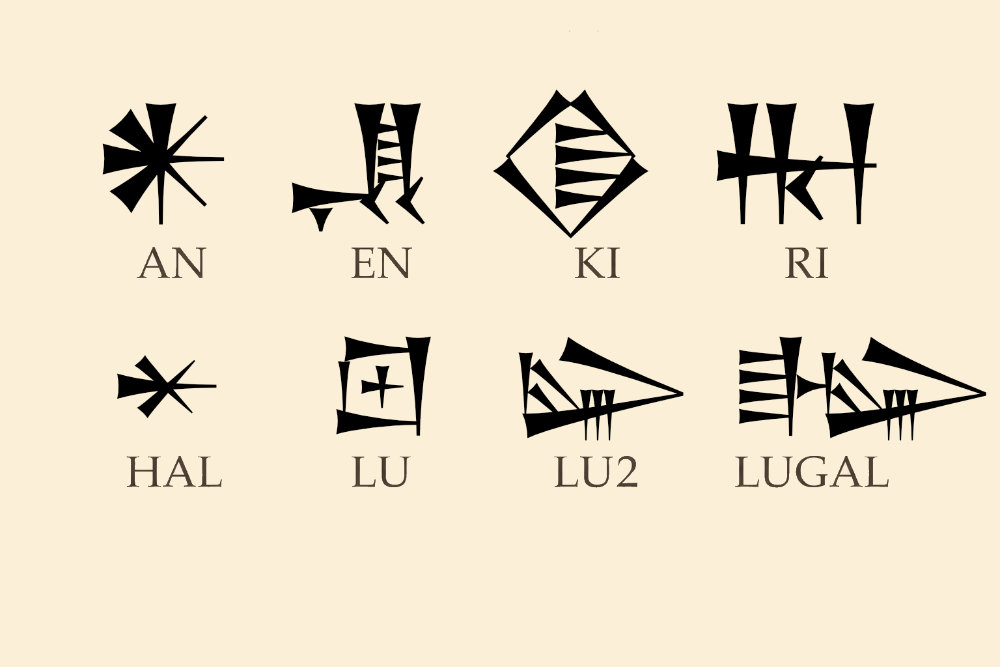
How robust this approach is can be demonstrated precisely on a sign that serves in the literature as a prime example of the arbitrariness of cuneiform signs: the sign for “sheep” (udu = LU = 𒇻). Glassner (2003) emphasizes that many of the earliest signs bore no resemblance whatsoever to the object they denoted, and cites this sign as a prominent example. Its proto-cuneiform form — a circle with an inscribed cross — does not evoke a sheep; it could just as well represent a wheel, a window, or a crosshair. Glassner’s conclusion: the sign is not a picture of a sheep but an abstract symbol invented within an administrative system. Its meaning, he argues, arises from convention, not from visual resemblance.
The apparent arbitrariness dissolves, however, as soon as one ceases to regard the sign as an attempt at a pictographic depiction of a sheep and instead analyzes it as a semantic composition of its components. The sign LU (𒇻) can be structurally described as LAGAB×MAŠ: the outer sign LAGAB (𒆸) functions as a framing sign and denotes an object that requires supervision, administration, or enclosure. The inscribed sign MAŠ (𒈦) stands for something that yields interest — in the broadest sense: returns or dues — for a second party. The combination of both components yields not the specific meaning “sheep” but a more general concept: a managed entity that generates returns for another party. In the case of a sheep, this second party is the owner of the animal, who benefits from wool, milk, and offspring. Significantly, the same sign 𒇻 can also denote a person — in which case the “second party” for whom returns are generated is the respective city god, to whom the person’s labor accrues.
This example illustrates that the supposed arbitrariness of many cuneiform signs may rest on the fact that scholarship proceeds from the wrong premise: it searches for pictographic resemblance between sign form and denoted object and notes its absence. If one instead reads the sign form as a semantic composition of sub-signs, each carrying its own meaning, a logic emerges that is neither pictographic nor arbitrary, but rests on a system of conceptual combinatorics.
Selz (2021) has pointed out in a foundational study that many so-called “logograms” — particularly compound and complex signs — carry a visual semantics that goes beyond a merely conventional assignment of form and meaning, and that the conventional term “logogram” inadequately captures the semiotic complexity of these signs. In a further contribution (Selz 2022), he develops this critique into a comprehensive reassessment of the origins of cuneiform. There, Selz argues against the widespread “logocentric” hypothesis, according to which writing served from the outset primarily to represent spoken language. Using the proto-cuneiform signs from the city of Uruk as his example, he argues that these signs did not render individual words of a specific language but rather represented meanings, concepts, and things independent of any particular language — a procedure termed “semasiographic.” A central argument is the pronounced polysemy of the signs. The fact that a single sign covers a broad semantic range fits poorly with the notion that a logogram stands for exactly one word — but it integrates seamlessly into a system in which signs represent not words but conceptual fields, whose concrete linguistic realization depends on context.
Particularly relevant for the argument pursued here is that Selz understands cuneiform as the product of a convergence of three sign systems: counting (the token system and numerical notation), pictorial representation (cylinder seals, reliefs), and language. Reducing writing to a mere tool for rendering spoken language, Selz argues, does not do justice to the complexity of the earliest writing system. Only a broader semiotic perspective unlocks the full communicative potential of cuneiform — and with it the insight that many signs do not operate as opaque units but as semantic compositions whose individual parts retain their contribution to meaning. Selz and Zhang (2024) have further elaborated this in comparative perspective, examining the principle of “appositive semantic classification” in Sumerian cuneiform and Chinese script.
Structure of the Article
This article is divided into two parts. The first part presents the Sumerian cuneiform system in its essential features: the structure of the sign inventory, the distinction between original meaning and syllabic meaning, the distinction between representations of processes and objects, and the material and graphic conventions that shape the system. This presentation is intended to provide the prerequisites for following the subsequent analysis. In the second part, selected cuneiform signs are used to demonstrate how their meaning can be derived from their form — more precisely: from the meanings of their identifiable sub-signs. The selection deliberately includes signs that denote abstract concepts and at first glance display no pictographic motivation, in order to test the viability of the compositional approach precisely where much of the existing scholarship posits semantic opacity.
Essential features of the cuneiform system
Material and writing technique
The material basis of cuneiform is the writing surface of clay combined with a reed stylus. In the proto-cuneiform period (c. 3300–2900 BCE), signs were incised into moist clay with a pointed stylus, which allowed curved lines still close to the pictogram. The decisive technical transformation occurred around the middle of the 3rd millennium BCE, when a blunt-tipped stylus was introduced whose angular tip was pressed rather than drawn into the clay. This technique produced the characteristic wedge-shaped impressions that give cuneiform its name and made writing faster, but restricted the formal repertoire to combinations of a few basic elements (Spar 2004; Cammarosano 2014). In its mature form, cuneiform consists of five basic wedge types: the horizontal wedge, the vertical wedge, two diagonal wedges, and the so-called Winkelhaken (Borger 2004).
The sign inventory: scope and structure
The Sumerian cuneiform inventory comprised approximately 800 to 1,500 signs in its earliest phase and was reduced to around 600 over the course of the 3rd millennium, with the exact number fluctuating between 600 and 900 depending on the period (Borger 2004; Crisostomo 2019). Structurally, the signs can be divided into three categories: primary signs, which function as indivisible units; compound signs, in which independent signs are placed in linear sequence; and complex signs, in which one sign is inscribed within another, notated in transliteration with × (ETCSL Sign List). This distinction is of central importance for the question of semantic transparency.
Original meaning vs. syllabic usage
Most signs are not confined to a single function but can, depending on context, be read as logograms (word signs) or as syllabograms (syllable signs) (Walker 1987; Borger 2004). In their logographic function, a sign stands for a word or concept. Syllabic usage arose through the rebus principle: signs could be used to represent their mere phonetic value (Spar 2004). This gives rise to two structural consequences: polyphony — a sign can possess multiple phonetic values — and homophony — a single phonetic value can be written with different signs. For the question pursued here, it is crucial that the syllabic use of a sign does not extinguish its original logographic meaning. Both functions coexist within the system.
Spatial and temporal dimensions of sign representation
For an understanding of the semantic structure of Sumerian cuneiform signs, a fundamental distinction must be drawn that has not been systematically elaborated in previous scholarship: the distinction between signs whose internal structure maps two spatial dimensions (snapshots) and signs whose structure combines one spatial dimension with one temporal dimension (space-time diagrams). In addition, there are complex signs composed of elements of both types.
Snapshots: Signs of the first type — two spatial dimensions — represent a state or a spatial configuration. They show how something is arranged in space or how the parts of a whole relate to one another. An example is the sign HAL (𒄬). It shows a horizontal line divided into two parts by a cross. The representation does not depict a temporal sequence but a spatial structure: something that is being divided into parts. Accordingly, the verbal meaning of HAL is “to divide something into parts” and its nominal meaning is “something that has been divided into parts.” The meaning is immediately apparent from the visual configuration of the sign: one sees the division, and that is precisely what the sign denotes.
Space-time diagrams: Signs of the second type — one spatial dimension and one temporal dimension — represent a process, that is, a change over time. The horizontal axis of the sign functions here not as a second spatial dimension but as a time axis, with time running from right to left — a convention that applies consistently to signs of this type. The vertical axis shows the spatial arrangement at a given point in time, with objects frequently represented as vertical lines. What the sign shows is therefore not a static image but a sequence: the same spatial area at two or more successive points in time. The sign RI (𒊑) illustrates this principle. It contains a horizontal line representing the horizon. At the first point in time — in the right-hand area of the sign — it shows a single vertical object. At the second point in time — in the left-hand area — it shows two vertical objects, one of which is marked. The sign thus describes a process in which a second, similar object has been added to an existing one. The meaning of RI either refers to the newly added object and means “to place, to add,” or it refers to the owner of the newly added object and means “to have achieved a great deal.” What determines the meaning is not the type of object, but the structural fact that an object has been newly added to other objects of the same kind.
The distinction between these two sign types is not a mere classification but unlocks the logic by which sign form and meaning are connected. Signs of type (a) encode a spatial structure, and their meaning derives from what that structure shows. Signs of type (b) encode a temporal change, and their meaning derives from the difference between the before and the after. In both cases, the meaning is readable from the form — not as pictographic resemblance to a concrete object, but as a visual representation of an abstract relation (division, addition). Furthermore, there exist complex signs that combine elements of both types, such as the sign for “sheep” (udu = LU = 𒇻 = LAGAB×MAŠ) discussed in the introduction, whose sub-signs each carry meanings derivable in the manner described and whose composition constitutes the overall meaning.
Entity derivation
There are markings on cuneiform signs that alter the meaning of the sign in a specific way. Among these is the addition of two vertical strokes in the lower left area of a sign. This modification shifts the meaning of the sign from the depicted action or process toward the abstract entity involved in that action — that is, toward what performs the action or what the action is performed upon.
The sign NI (𒉌) illustrates this principle. Without the modification, it shows an open mouth in profile — someone speaking. The two vertical strokes shift the meaning from “to speak” toward “that which speaks.” What speaks is not the mouth as a body part but the self of a person — one’s inner self, which expresses itself through speech. Accordingly, 𒉌 means “self.”
The sign BI (𒁉) shows a metal rod being bent over an anvil. The two vertical strokes shift the meaning from “to bend” toward “that which is bent.” What is bent is the raw material undergoing processing. Accordingly, 𒁉 means “raw material.”
The sign GA₂ (𒂷) shows an object — represented as a vertical stroke — that carries or contains something. What is carried or contained is tracked over time, which is why it is represented as a horizontal line. The two vertical strokes shift the meaning from “to contain something” toward “that which contains something.” Depending on context, it can therefore denote a basket, a chest, a stable, or a house — what all these meanings share is not the concrete shape of the object but the abstract property of being a container.
The procedure is the same in all three cases: the base form of the sign represents an action or process; the modification through two vertical strokes redirects attention from the process to its bearer. The resulting meaning is always abstract — not a specific object but a category of objects defined by their role in the depicted process.
Further sign modifications
The sign inventory was also expanded in other ways through the systematic modification of individual signs. The tradition distinguishes three main procedures: gunû (addition of extra wedges), šešig (cross-hatching with Winkelhaken), and tenû (tilting by approximately 45°). These procedures show that the relationship between sign form and meaning is not arbitrary: the modification of form presumably stands in a comprehensible relationship to the modification of meaning, although this relationship has in some cases yet to be deciphered.
Meanings of selected signs
In the following, the meanings of selected Sumerian cuneiform signs are derived from their visual structure. For each sign, the graphic elements are first described and the meaning derived from the composition of these elements. The collection is conceived as a working document and will be continuously expanded. The signs are ordered alphabetically by sign name.
An operator notation is used to describe the syntactic function of the signs, corresponding to the notation in the R package sumer and explained in detail in that package’s vignette (Wellmann 2026). The essentials are briefly summarized here.
Old Sumerian words can assume three basic types: noun (S), verb (V), and attribute (A). In addition, words can be used as operators that take a word of a specific basic type as an argument and return a result of a — possibly different — basic type. In the operator notation, the symbol ☒ denotes the position of the sign itself. Thus the notation S☒→S means that the sign (☒) expects a noun (S) as an argument on its left side and returns a noun (S) as its result. Correspondingly, ☒S→S means that the argument is on the right side of the sign. A sign can possess multiple such operator functions depending on context.
Discussion
The analyses presented in this article challenge the consensus prevalent in Assyriology that the meaning of Sumerian cuneiform signs cannot be derived from their visual form. The findings suggest that this consensus rests on a narrowed framing of the question: previous scholarship asks whether a cuneiform sign pictographically resembles the object it denotes and rightly notes that in most cases it does not. The alternative proposed here asks instead whether the meaning of a sign can be derived from the meanings of its graphic components — and arrives at a considerably more positive result.
A central contribution of this article is the distinction between snapshots and space-time diagrams. This distinction has not been described as a systematic principle in previous literature, despite proving to be a key to deriving meaning. Snapshots encode spatial configurations and are suited to the representation of states, structures, and simple processes — such as the process of division in HAL (𒄬). Space-time diagrams, by contrast, encode processes by showing the same spatial area at different points in time — such as the process of addition in RI (𒊑). The fact that the time axis in space-time diagrams consistently runs from right to left points to a deliberate convention that pervades the system.
A further contribution is the identification of entity derivation through two vertical strokes as a productive modification procedure. The regularity with which this procedure shifts the meaning from the depicted action to its bearer — from “to speak” to “self” (NI, 𒉌), from “to bend” to “raw material” (BI, 𒁉), from “to contain” to “container” (GA₂, 𒂷) — suggests that this is a systematic principle, not a set of isolated cases.
To be sure, the method presented here is not without limitations. This article does not claim that all Sumerian cuneiform signs can be analyzed in the manner described, nor does it claim to present a definitive characterization of cuneiform signs. The claim is rather to show that the compositional approach is applicable to a larger portion of the sign inventory than previous scholarship suggests — and that the supposed arbitrariness of many signs, upon closer analysis, gives way to a comprehensible logic.
Furthermore, the relationship of the analysis proposed here to the temporal development of cuneiform has not yet been fully clarified. The analyses relate primarily to sign meanings in the Old Sumerian and Old Babylonian periods. Whether and to what extent the principles described are applicable to subsequent periods remains an open question.
Conclusion
Sumerian cuneiform is not a system of arbitrary assignments of sign form and meaning, nor is it a system of faded pictograms whose former pictorial quality has been lost. It is a system of semantic compositions in which the meaning of compound and complex signs emerges from the meanings of their sub-signs. The apparent opacity of many signs dissolves as soon as one stops searching for the depiction of concrete objects and instead focuses on the abstract logic of sign composition.
The analytical framework developed here — the distinction between snapshots and space-time diagrams, the identification of systematic modification procedures, and the operator notation for describing syntactic functions — provides a tool with which this logic can be uncovered sign by sign. The sign analysis, conceived as a continuously expanding collection, is intended to realize this undertaking step by step and thereby contribute to understanding the oldest writing system in human history for what it is: an internally coherent system whose signs reveal more than we have so far learned to see.
Literature
- Borger, R. 2004. Mesopotamisches Zeichenlexikon (MesZL). Münster: Ugarit-Verlag.
- Cammarosano, M. 2014. “The Cuneiform Stylus.” Mesopotamia 49: 53–90.
- Crisostomo, C.J. 2019. “Introduction to Cuneiform Sign Lists.” Digital Corpus of Cuneiform Lexical Texts: Sign Lists. The DCCLT Project. http://oracc.museum.upenn.edu/dcclt/signlists/signlists/
- Englund, R.K. 1998. “Texts from the Late Uruk Period.” In P. Attinger and M. Wäfler (eds.): Annäherungen 1: Mesopotamien. Späturuk-Zeit und Frühdynastische Zeit (OBO 160/1). Freiburg Schweiz/Göttingen: Universitätsverlag/Vandenhoeck & Ruprecht, 13–233.
- Glassner, J.-J. 2003. The Invention of Cuneiform: Writing in Sumer. Baltimore: Johns Hopkins University Press.
- Goldwasser, O. 2017. “Cuneiform and Hieroglyphs in the Bronze Age: Script Contact and the Creation of New Scripts.” In P. Pearce, P. Creasman, and R.H. Wilkinson (eds.): Pharaoh’s Land and Beyond. Oxford: Oxford University Press, 183–193.
- Nissen, H.J. 1986. “The Archaic Texts from Uruk.” World Archaeology 17: 317–334.
- Nissen, H.J., P. Damerow, and R.K. Englund. 1993. Archaic Bookkeeping: Early Writing and Techniques of Economic Administration in the Ancient Near East. Chicago: University of Chicago Press.
- Powell, M.A. 1981. “Three Problems in the History of Cuneiform Writing: Origins, Direction of Script, and Literacy.” Visible Language 15 (4): 419–440.
- Selz, G.J. 2021. “The Puzzling Logogram: Writing and Reasoning in Early Mesopotamia.” In G. Gabriel, K. Overmann, and A. Payne (eds.): Signs – Sounds – Semantics. Nature and Transformation of Writing Systems in the Ancient Near East (WOO 13). Münster: Ugarit-Verlag, 27–47.
- Selz, G.J. 2022. “Beyond Speech: Advocating a Non-Logocentric View on the Evolution of Cuneiform Writing.” In D. Wengrow (ed.): Image, Thought, and the Making of Social Worlds (FSAVK 3). Heidelberg: Propylaeum, 213–249.
- Selz, G.J. and B. Zhang. 2024. “Classification in Sumerian Cuneiform and the Implementation of iClassifier.” Journal of Chinese Writing Systems 8 (1): 59–78. DOI: 10.1177/25138502231215875.
- Spar, I. 2004. “The Origins of Writing.” In Heilbrunn Timeline of Art History. New York: The Metropolitan Museum of Art. https://www.metmuseum.org/essays/the-origins-of-writing
- Schmitt, R. 1993. “Cuneiform Script.” Encyclopaedia Iranica (online edition). https://www.iranicaonline.org/articles/cuneiform-script/
- ETCSL Sign List (compiled by S. Tinney). Electronic Text Corpus of Sumerian Literature. University of Oxford. https://etcsl.orinst.ox.ac.uk/edition2/signlist.php
- Walker, C.B.F. 1987. Cuneiform. Berkeley: University of California Press.
- Wellmann, R. 2026. sumer: Sumerian Cuneiform Text Analysis. R package, version 1.4.0. https://CRAN.R-project.org/package=sumer