
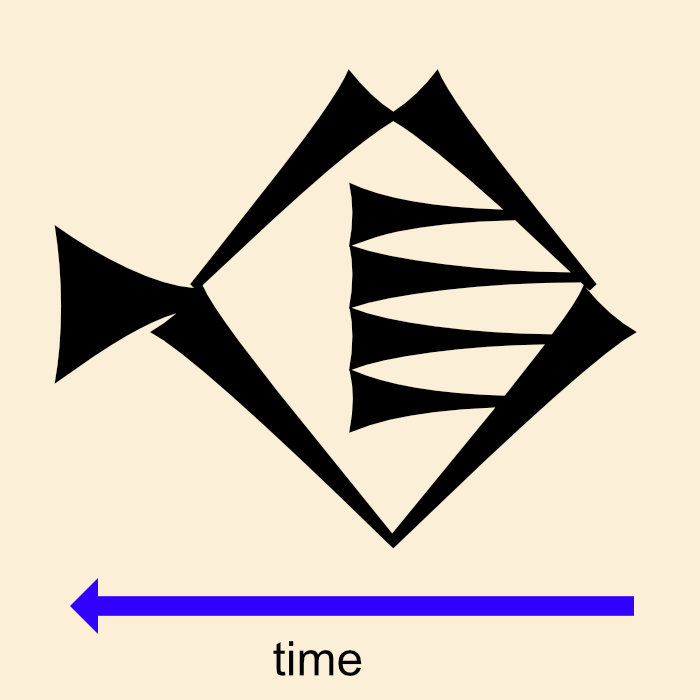
Cuneiform sign: 𒈾
Sign name: NA
Phonetic values: na
UTF-8 Symbol: U+1222C
Category: Space-time diagram
Sub-signs: - + 𒄭 + ≣
Visual analysis: The frame sign 𒄭 delimits an area that shows how the scope of action of a mortal human being changes over time: at the time of birth it is small, then it steadily increases, until it decreases again toward the end of life. Here, the four horizontal strokes ≣ stand for a conscious being. The sign thus stands for the scope of action of a human being. The horizontal stroke on the left shows that the scope of action of the person concerned is already significantly restricted well before the end of their life. What stands to the left of the sign indicates the reason for this. The reason is usually that the person is bound to something or someone.
Derived meaning: The derived meaning is "to be bound to something/someone."
Usage: There are different types of usage:
- As a verb, the sign 𒈾 has the meaning "to be bound to someone/something." As an operator S☒→A, it indicates to what or whom someone is bound. It then has the reading "who is bound to S."
- In addition, the sign also has the meaning "stone." The reason is presumably that large stones are bound to their place: their position can hardly be changed.
- As a verbal element S☒V→V, the sign 𒈾 adds to the verb a restriction or specification of the form "that is bound to S." Example: "to decree a destiny that is bound to the repayment of debts."
Conventional interpretation: stone, destiny, providence, fixed order