Cuneiform sign: 𒆠
Sign name: KI
Phonetic values: ki, ge5, gi5, ke, qi2
UTF-8 Symbol: U+121A0
Category: Space-time diagram
Sub-signs: 𒄭 + ≣
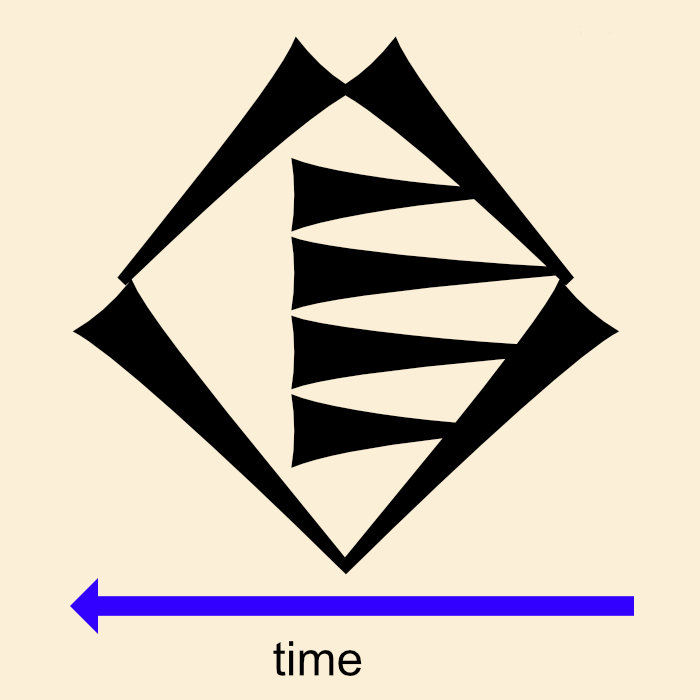
Visual analysis: Time flows from right to left. The frame sign 𒄭 delimits an area that shows how the scope of action of a mortal being changes over time: at the time of birth it is small, then it steadily increases, until it decreases again toward the end of life. The sign 𒄭 thus represents the totality of possibilities that someone has.
However, if the focus is placed not on the interior of the area, but on its edge, then the meaning changes to: "that which restricts the scope of action of a person." In order not to mix the two meanings, there is a separate sign for this: the sign 𒆠. Here, the four horizontal strokes ≣ stand for a conscious being. The sign 𒆠 thus stands for that which fundamentally restricts the scope of action of a conscious human being.
Derived meaning: The sign has the meaning "that which restricts the scope of action of a person." Unlike the gods, humans are bound to a place, which restricts their scope of action. Therefore, the main meanings of the sign are "place," "city," and "earth." In addition, humans are also bound to other humans, which likewise restricts their scope of action. A further meaning of the sign is therefore "binding to a person."
Usage: There are different types of usage:
- As a noun, the sign 𒆠 has the meanings "Earth," "city," "that to which people are bound," and "binding to a person."
- As an operator S☒→S, the sign 𒆠 marks the name of a city. In this case, it means: "city that is characterized by S."
Conventional interpretation: place, land, earth, work