
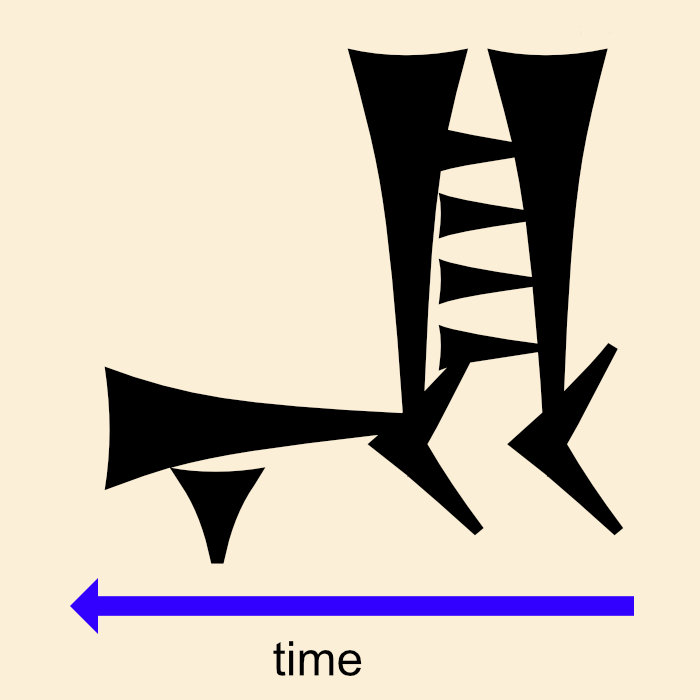
Cuneiform sign: 𒂗
Sign name: EN
Phonetic values: en, in4, ru12, uru16
UTF-8 Symbol: U+12097
Category: Space-time diagram
Sub-signs: none
Visual analysis: Time flows from right to left. On the right side of the sign there are two vertical strokes underneath which markings are placed. The same arrangement of signs is found on the left side of the sign NAM = 𒉆, which describes the process of assigning destiny. The sign thus stands for someone with an assigned destiny. The actions of the person are therefore determined not only by the person themselves, but also by the gods. One of the two vertical strokes stands for the person themselves, the other stroke stands for the responsible god. The four horizontal strokes presumably symbolize the options the person has for achieving the goals of the gods. The horizontal stroke AŠ = 𒀸 on the left side could stand for "preparing something planned." Near the end of the stroke, a marking is placed.
Derived meaning: The sign stands for a significant person with a divinely decreed destiny, who selects from the options available to them in order to prepare that which has been planned by the gods.
Usage: There are different types of usage:
- If the focus lies on the left side of the sign, as the marking suggests, then the task of the person is the preparation of something planned. In this case, the person could briefly be called a "cultural leader."
- If the focus lies on the right side, that is, on the fact that the person's destiny has been divinely decreed, then they could be designated as a "priest."
Conventional interpretation: dignitary, lord, high priest