
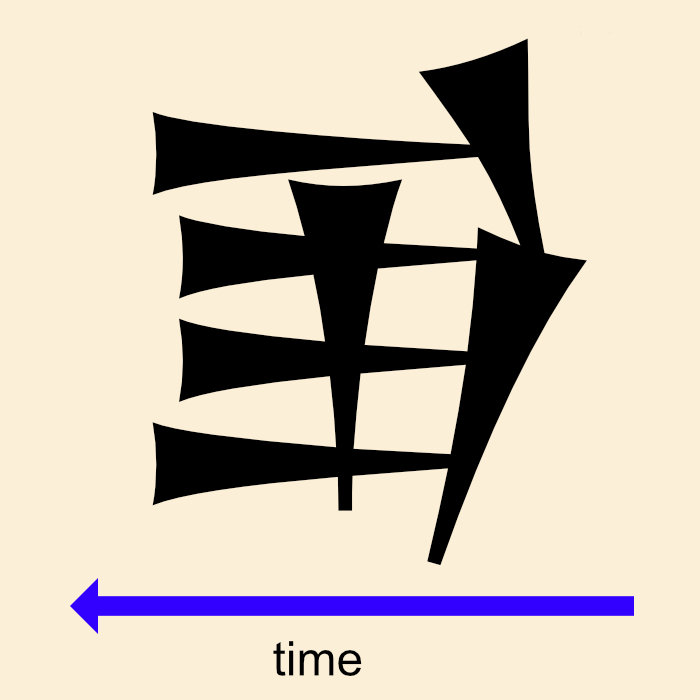
Cuneiform sign: 𒂊
Sign name: E
Phonetic values: e, eg2
UTF-8 Symbol: U+1208A
Category: Space-time diagram
Sub-signs: none
Visual analysis: Time flows from right to left. The obtuse angle on the right marks that a process is unfolding. The 4 horizontal strokes symbolize the effects of this process. The vertical stroke in the middle symbolizes an object that is affected by the effects of the process. An unfolding process thus has an impact on the object as its consequence.
Derived meaning: The primary meaning of the sign 𒂊 is therefore "to have something as a consequence" or "to entail something."
Usage: There are different types of usage:
- If there is a noun phrase S on the left side, then the sign 𒂊 can be understood as an operator S☒→S and means: "that which is the consequence of S," or "that which S brings with it." If, in addition, there is a complex verb V on the right side (normally as a combination: object + transitive verb), then the sign can alternatively be understood as a verbal prefix and means "to have V as a consequence" or "to entail V".
- As a noun S, the sign 𒂊 stands for an object that must withstand a particular unfolding process. This object is symbolized by the vertical stroke in the middle. In this case, the sign usually has the meaning "dike" or "levee."
- As a verb, the sign 𒂊 has the meaning "to have as a consequence."
Conventional interpretation: marker of the subject of a transitive verb, dike, levee