
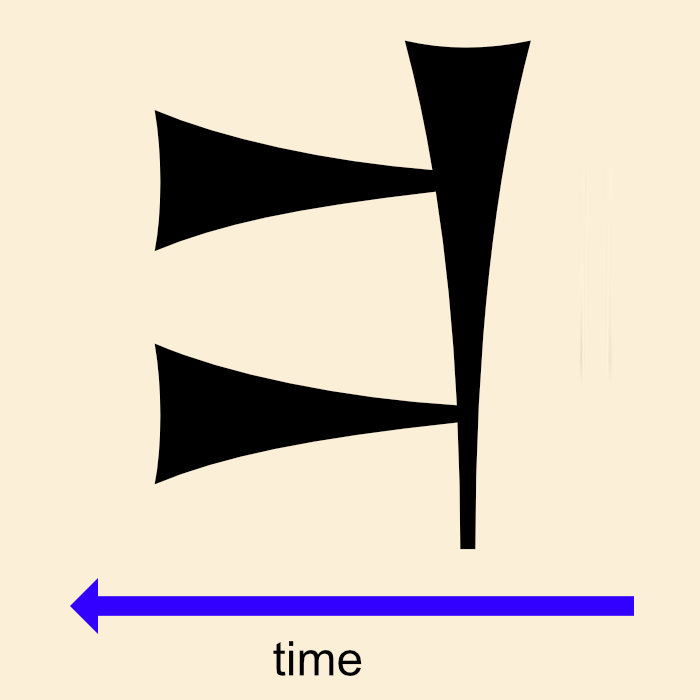
Cuneiform sign: 𒄑
Sign name: GIŠ
Phonetic values: ĝiš, is, iš₆, iz
Unicode-Codepoint: U+12111
Category: Space-time diagram
Sub-signs: none
Visual analysis: Time runs from right to left. The vertical stroke shows an action that acts upon an object. As a result of this action, a collection of multiple objects emerges. The objects of the collection are tracked over time, which is why they appear as horizontal strokes.
Derived meaning: The sign has three possible meanings. If the focus is placed on the act of intervention, the meaning of the sign is “invasive action.” If the focus is placed on the resulting collection of objects, the meaning of the sign is “produced/manufactured collection.” If the focus is placed instead on the object that is acted upon, the meaning is “wood” or “tree,” since implements that can be conceived as collections of individual parts were typically made from wood.
Usage: There are three different modes of usage:
- When the sign is used with the meaning “invasive action,” it functions as an operator S☒→S with its argument on the left side. In this case, the noun on the left describes the object that is acted upon.
- When the sign is used with the meaning “produced/manufactured collection,” it functions as an operator ☒S→S with its argument on the right side. In this case, the noun on the right further specifies what kind of collection is meant. Frequently, this refers to a tool made from wood, which is here conceived as a collection of its individual parts.
- As a standalone noun S, the sign has aither the meaning “tree” or “wood,” since most tools were made from wood, or it means “invasive actor”.
Conventional interpretation: tree, wood, wooden tool.